
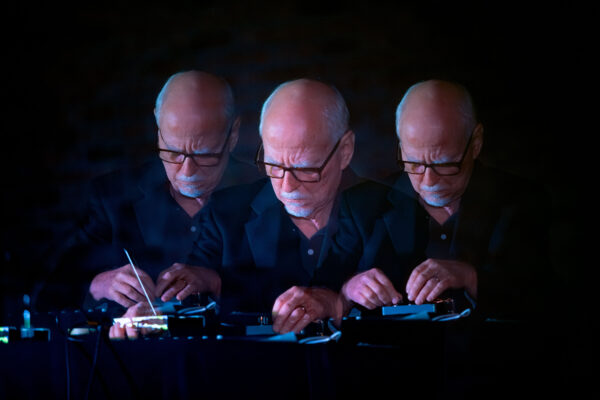
John Bischoff (b. 1949, San Francisco) is an early pioneer of live computer music. He is known for his solo constructions in real-time synthesis as well as the development of computer network music. His recent performances combine hands-on analog circuitry and digital synthesis in open dialog. Sonic attributes in one domain inform music unfolding in the other. The ebb and flow of discontinuity in these systems spontaneously generates form. He has been active in the experimental music scene in the Bay Area for over 40 years as a composer, performer, and teacher. His performances around the US include NEW MUSIC AMERICA festivals, Roulette and Experimental Intermedia in New York, and the Lampo Series in Chicago. He has performed in Europe at the Festival d’Automne in Paris, Akademie der Künste in Berlin, STEIM in Amsterdam, and Fylkingen in Stockholm. He is a founding member of the LEAGUE OF AUTOMATIC MUSIC COMPOSERS, the world’s first computer network band, and co-authored an article on the LEAGUE’s music that appeared in “Foundations of Computer Music” (MIT Press 1985). He is also an original member of THE HUB, a band he has performed and recorded with for over 3 decades. He was on faculty for many years in the legendary Music Department at Mills College. Recordings of his work are available on Artifact Recordings, Lovely Music, Tzadik, 23Five, Centaur, and New World Records.
Notes on tonight’s performance:
In recent years I have been composing solo pieces using custom analog circuits in tandem with digital synthesis. The circuits produce audio and sub-audio pulsewaves in response to hands-on actions by the performer. Three of the pieces I will perform — “Bitplicity”, “Tone”, and “Visibility Study” — have the following features in common:
- as pulsed tones come to life, they sound at the loudspeakers and may trigger digital sound directly at the same time
- the pulsed tones are also analyzed by the laptop for elapsed time between events. The timing of subsequent digital synthesis generated by the laptop is driven by this performance-acquired timing data — no pre-performance timing data is employed
- as the laptop generates sound it is open to interruption and re-animation by ongoing circuit actions. The very ground of each circuit action is a physical interruption — a disturbance in a continuous tone or silence.
“Calliope” is a different case—it is a take-off on Leon Theremin’s RHYTHMICON which automatically reiterates its tones at rates corresponding to the ratios of pitches selected by a performer via a keyboard. Theremin’s instrument is so beautifully elegant, and sonically quirky at the same time, that I wanted to build a digital synthesis version on the same principles — but where the instrument has internal drift in multiple dimensions. As the pitch combinations persist, they appear to disassemble in time.
(photo: Orpheus Roswell, 2025)
Curated by RM Francis for Nonsequitur’s NonSeq series.